
132 Hour OSHA Professional Course: Complete Guide
Every year, workers are injured — sometimes fatally — in incidents that proper hazard recognition and safety planning could have prevented. Falls, electrical contact, struck-by incidents, and confined space accidents remain among the leading causes of workplace injury across construction, manufacturing, and industrial settings. Behind every safe worksite is usually a trained safety professional who understands how to spot hazards before they become accidents, how to build a safety culture, and how to keep documentation that protects both workers and employers.
This is where structured occupational safety and health training becomes valuable. The Occupational Safety and Health Administration (OSHA) has spent decades shaping how workplace hazards are understood and controlled in the United States, and its principles have influenced safety practice around the world. Many people entering the safety field — students, technicians, supervisors, engineers, and career changers — look for training programs that go beyond a short awareness class and offer deeper, more structured learning.
A 132 Hour OSHA Professional course is one such option: an extended, OSHA-principles-based training program offered by private training providers for people who want broader exposure to occupational safety and health topics than a brief introductory class can provide. It is not the same thing as OSHA’s own Outreach Training Program, and understanding that distinction matters enormously before you enroll anywhere.
In this guide, you’ll learn exactly what a 132 Hour OSHA Professional course typically involves, who it’s designed for, what topics it may cover, how it compares with OSHA’s official 10-Hour and 30-Hour Outreach classes, what kind of certificate you can expect, and how to evaluate a training provider before you commit your time and money. The goal is simple: to give you an accurate, practical picture so you can make an informed decision about your safety education.

1. What Is a 132 Hour OSHA Professional Course?
A 132 Hour OSHA Professional course is an extended-format training program, offered by a private training provider, that is built around OSHA-based occupational safety and health principles. The “132 hour” figure refers to the total instructional time the program is designed to cover — significantly longer than OSHA’s own 10-hour or 30-hour Outreach classes.
The idea behind a longer program like this is straightforward: a 10-hour class is meant to build basic hazard awareness, and a 30-hour class adds more depth for supervisors, but neither is designed to function as a full professional education in occupational safety and health. A 132-hour course, by contrast, has enough instructional time to walk through hazard recognition, risk assessment, PPE, construction and industrial safety, incident investigation, documentation, and safety management concepts in far more detail — closer to what a working safety officer needs to know day to day.
It’s important to understand that the exact curriculum, structure, and hour breakdown of a 132-hour program can vary from one training provider to another. There is no single, standardized “132 Hour OSHA Professional” syllabus mandated by OSHA or any government body. Each provider builds its own course structure, so the specific modules, assessments, and learning outcomes you’ll encounter depend entirely on the organization delivering the training.
For students and professionals who want more than a short introductory class but aren’t yet ready for a full academic safety degree, this kind of extended professional training can serve as a practical middle ground — provided you choose a provider that is transparent about its syllabus, instructors, and what the completion certificate actually represents.
2. Understanding OSHA
The Occupational Safety and Health Administration (OSHA) is a federal agency within the U.S. Department of Labor. OSHA was created to ensure safe and healthful working conditions by setting and enforcing standards, and by providing training, outreach, education, and assistance to employers and workers.
At its core, OSHA’s mission touches several areas that anyone in the safety field needs to understand:
Hazard recognition — identifying conditions or practices in the workplace that could cause injury, illness, or death. This includes physical hazards (falls, machinery, electrical), chemical hazards, biological hazards, and ergonomic hazards.
Hazard prevention and control — once a hazard is identified, safety professionals apply controls to eliminate or reduce the risk. This typically follows a hierarchy: eliminate the hazard, substitute it with something safer, apply engineering controls, use administrative controls, and finally rely on personal protective equipment as a last line of defense.
Employer responsibilities — under the Occupational Safety and Health Act, employers are required to provide a workplace free from recognized hazards, comply with applicable OSHA standards, and keep records of certain workplace injuries and illnesses.
Worker rights — workers have the right to a safe workplace, the right to receive information and training about hazards, the right to request an OSHA inspection, and the right to report injuries without fear of retaliation.
Workplace safety culture — beyond rules and standards, OSHA promotes the idea that safety should be embedded in how an organization operates day to day, not treated as a separate, occasional activity. A strong safety culture depends on leadership commitment, worker participation, and continuous hazard identification.
Understanding these fundamentals is the foundation of almost any occupational safety and health training program, including a 132 Hour OSHA Professional course — because these principles, not a specific government checklist, are usually what such courses are built around.
3. Is 132 Hour OSHA Professional an Official OSHA Certification?
This is the single most important question anyone considering this course should ask — and the honest answer is no. A 132 Hour OSHA Professional course is not an official OSHA certification, not an OSHA Outreach course, and not a government-issued license. It is a privately developed training program that uses OSHA principles as its subject matter.
To understand why this distinction matters, it helps to know how OSHA’s own training system actually works.
OSHA operates something called the Outreach Training Program, which offers 10-hour and 30-hour classes (plus specialized versions for maritime and disaster site work) delivered exclusively by OSHA-authorized trainers. These trainers go through their own authorization process with OSHA and are permitted to issue official student course completion cards — often called “OSHA cards” or “DOL cards” — to people who finish the required hours and topics.
Here’s the critical part, straight from OSHA itself: an OSHA card is not considered a certification or license, and none of the courses within the Outreach Training Program is considered a certification. Even OSHA’s own 10-hour and 30-hour cards — the closest thing to an “official OSHA credential” that exists — are not certifications. They are completion cards confirming that a person attended and finished a specific voluntary training program.
So where does that leave a 132-hour course offered by a private training provider? It sits outside the Outreach Training Program entirely. It is not delivered under OSHA’s authorization system, and completing it does not result in an OSHA card. What you receive instead is a certificate of completion issued by the training provider itself — a document that shows you completed that provider’s course, not a government-issued qualification.
This doesn’t mean the training has no value. Extended, well-structured safety training can build genuinely useful knowledge and skills. But students should never assume that “OSHA” in a course name means the course is run by, authorized by, or endorsed by the government agency. OSHA authorized outreach trainers are not OSHA personnel, and trainers are authorized — not certified — to deliver Outreach classes; the terminology confusion is common even within the official Outreach system, so it’s especially important to check claims carefully with any provider offering a non-Outreach, extended-hours course.
Always verify directly with the training provider:
- Whether the course is part of OSHA’s Outreach Training Program (it should say so explicitly and be delivered by an OSHA-authorized trainer if it is)
- What exact document you receive at the end
- Whether that document is recognized by employers you’re targeting
- Whether the provider has any independent accreditation, and from which body
4. 132 Hour OSHA Professional Course vs OSHA 10-Hour and OSHA 30-Hour
The table below compares a typical 132-hour professional training program with OSHA’s official 10-hour and 30-hour Outreach classes.
| Feature | 132 Hour Professional Training | OSHA 10-Hour | OSHA 30-Hour |
| Training duration | 132 instructional hours (provider-defined) | 10 hours | 30 hours |
| Main purpose | Broader, professional-level safety education | Basic hazard awareness for entry-level workers | Deeper awareness for supervisors and workers with safety duties |
| Intended audience | Aspiring and current safety professionals, supervisors, engineers, students | Entry-level construction or general industry workers | Supervisors, foremen, workers with some safety responsibility |
| OSHA Outreach status | Not part of the OSHA Outreach Training Program | Official OSHA Outreach class | Official OSHA Outreach class |
| Certificate/card | Provider-issued certificate of completion (not a government card) | OSHA/DOL Outreach completion card | OSHA/DOL Outreach completion card |
| Certification/license? | No — training, not certification or license | No — a completion card, not a certification | No — a completion card, not a certification |
| Practical learning | Can be broad and detailed, depending on provider design | Focused, introductory-level coverage | More detailed than 10-hour, still an overview |
A few things stand out from this comparison. First, none of these three options is a certification or license — that’s true even for OSHA’s own Outreach classes. Second, only the 10-hour and 30-hour classes are officially part of OSHA’s Outreach Training Program and only those result in an OSHA/DOL card. Third, a 132-hour program’s main advantage is instructional depth and breadth — it simply has more time to cover more ground — but that depth is only as good as the specific provider’s curriculum design, since there’s no standardized national syllabus for a course of this length.
If your goal is specifically to obtain an official OSHA/DOL Outreach card because an employer, city, or state requires it, you need to enroll in a 10-hour or 30-hour class delivered by an OSHA-authorized trainer — a 132-hour professional program will not produce that card, no matter how comprehensive it is.
5. Who Should Take 132 Hour OSHA Professional Training?
Extended safety training programs tend to attract a broad mix of people, each with different starting points and goals:
Safety officers and HSE officers looking to deepen their working knowledge beyond what they picked up on the job.
Safety supervisors and site supervisors who need a more structured understanding of hazard control, documentation, and incident investigation to support their existing responsibilities.
Engineers and technicians working in construction, manufacturing, or industrial settings who want a stronger grasp of safety principles relevant to their projects.
Construction and industrial workers who want to move from hands-on trade roles into safety-focused positions.
Fresh graduates and diploma holders exploring occupational safety and health as a career path and looking for structured, in-depth exposure to the field before applying for entry-level roles.
Students studying engineering, industrial technology, environmental science, or related fields who want practical safety knowledge to complement their academic background.
Managers with safety responsibilities who need to understand hazard identification and compliance concepts well enough to lead teams and make informed decisions.
Career changers moving into safety from another profession entirely, who need a broader foundation than a short course can provide.
It’s worth repeating: exact eligibility and suitability depend on the specific training provider. Some providers design their 132-hour course for complete beginners, while others assume some prior workplace or technical background. Always check the provider’s own description of who the course is intended for before enrolling.
6. Eligibility Requirements
Because a 132 Hour OSHA Professional course is not a standardized, government-regulated program, there is no single universal eligibility requirement that applies across every provider. That said, here are the general areas providers typically consider:
Educational background — many providers accept students with a high school diploma, intermediate certificate, or equivalent, though some may prefer candidates with a diploma or degree in engineering, science, or a related technical field.
Work experience — some programs are designed for complete beginners with no prior safety experience, while others may be more useful for people who already have some exposure to a workplace environment, since practical examples will make more sense with that context.
English language considerations — since most OSHA-based training material is developed and delivered in English, a working level of English comprehension is usually necessary, particularly for online, self-paced formats.
Technical background — a technical or engineering background isn’t always required, but it can help students grasp certain topics — such as electrical safety or machine guarding — more quickly.
Whether beginners can enroll — many extended safety courses are explicitly designed to take a learner from foundational concepts through to more advanced material, meaning prior experience often is not mandatory.
If a specific training provider has not published clear eligibility criteria, the safest approach is to contact them directly and ask before enrolling. Do not assume requirements based on what other providers advertise — confirm them with the organization offering the specific course you’re considering.
7. What Will You Learn in a 132 Hour OSHA Professional Course?
A comprehensive 132-hour program may cover topics such as the following. Keep in mind that the exact syllabus, depth, and hour allocation for each topic will differ between training providers — this list represents common subject areas found across professional occupational safety and health training, not a fixed or guaranteed curriculum.
OSHA fundamentals — an overview of OSHA’s role, structure, and the general principles behind occupational safety and health regulation in the United States.
Occupational safety and health principles — the core ideas behind protecting workers from injury and illness, including hazard recognition, evaluation, and control.
Workplace hazard identification — how to systematically look for hazards across different types of work environments.
Risk assessment — evaluating the likelihood and severity of a hazard causing harm, and prioritizing which risks need attention first.
Risk control and the hierarchy of controls — elimination, substitution, engineering controls, administrative controls, and PPE, in that order of preference.
Personal protective equipment (PPE) — selection, use, limitations, and maintenance of protective gear.
Fall protection — hazards associated with working at height and the controls used to prevent falls.
Scaffolding safety — safe erection, use, and inspection of scaffolding systems.
Ladder safety — proper selection, setup, and use of ladders in various work settings.
Electrical safety — recognizing electrical hazards and understanding basic control measures.
Fire safety — fire hazard recognition, prevention, and basic response principles.
Emergency preparedness — planning for emergencies, evacuation procedures, and coordination during incidents.
Chemical safety and hazard communication — understanding safety data sheets, labeling, and safe handling of hazardous substances.
Lockout/tagout — controlling hazardous energy during equipment maintenance and servicing.
Machine guarding — protecting workers from moving machine parts.
Material handling — safe lifting, storage, and movement of materials.
Ergonomics — reducing strain and injury risk related to posture, repetitive motion, and workstation design.
Confined space safety — hazards and precautions associated with entering confined or enclosed spaces.
Excavation and trenching safety — hazards specific to digging and trench work.
Construction safety — hazards and controls specific to construction sites.
Industrial safety — hazards and controls specific to manufacturing and industrial facilities.
Environmental health and safety (EHS) — the broader intersection of workplace safety and environmental compliance.
Accident prevention and incident investigation — understanding root causes and preventing recurrence.
Safety inspections and audits — systematic reviews of workplace conditions and safety management systems.
Toolbox talks — short, regular safety discussions used to reinforce hazard awareness on-site.
Safety documentation — records that support compliance, accountability, and continuous improvement.
Safety management systems — organizational structures and processes that support ongoing safety performance.
Safety leadership and safety culture — how leadership behavior and organizational values shape safety outcomes.
Workplace health — broader health considerations connected to occupational exposure and wellbeing.
Again, not every provider’s 132-hour course will cover every topic listed above in the same depth, and some providers may include additional or different modules. Always request a detailed syllabus before enrolling so you know precisely what you’ll be studying.
8. Hazard Identification and Risk Assessment
Hazard identification is the starting point of virtually every safety process. It means actively looking for anything in the workplace that has the potential to cause harm — a damaged ladder, an unguarded machine part, a poorly ventilated storage room, or a repetitive task that strains the back.
Once a hazard is identified, risk assessment comes next. This typically involves estimating two things: likelihood (how probable is it that this hazard will actually cause harm?) and severity (if it does cause harm, how serious would the outcome be?). Combining these two factors produces a risk rating, which helps safety teams decide what to address first.
After a hazard is rated, appropriate control measures are selected — ideally following the hierarchy of controls, starting with elimination and working down toward PPE. Monitoring then ensures that controls remain effective over time, since workplace conditions change.
Realistic example: Consider a warehouse where forklifts and pedestrian workers share the same aisles. A hazard identification walk-through reveals that pedestrians frequently cross forklift paths without clear visibility in either direction. The risk assessment rates this as high likelihood (it happens daily) and high severity (forklift-pedestrian collisions can be fatal). The safety team responds by installing physical barriers and dedicated pedestrian walkways (engineering control), setting speed limits and right-of-way rules (administrative control), and requiring high-visibility vests for anyone on foot in the warehouse (PPE) — applying multiple layers of the hierarchy rather than relying on a single fix.
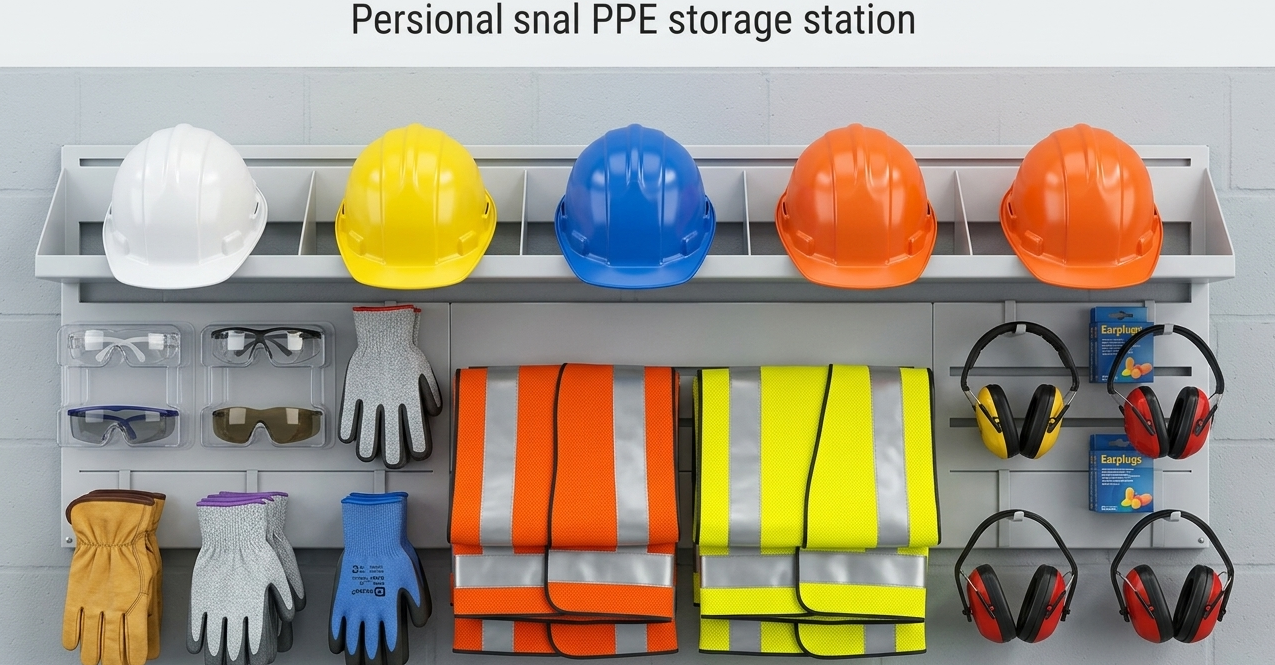
9. Personal Protective Equipment
PPE is often the most visible part of workplace safety, but it’s important to understand it as the last line of defense, not the first solution. Common categories include:
- Helmets/hard hats — protection against falling objects and head impact
- Safety glasses/goggles — protection from flying debris, dust, and chemical splash
- Gloves — protection against cuts, chemical exposure, or thermal hazards, selected based on the specific task
- Safety footwear — protection against crushing, puncture, and slip hazards
- Hearing protection — earplugs or earmuffs for high-noise environments
- Respiratory protection — masks or respirators for airborne contaminants, fitted and selected according to the specific exposure
- Fall protection equipment — harnesses, lanyards, and anchor points for work at height
- High-visibility clothing — used in environments with vehicle or equipment traffic
PPE only works when it’s the right type for the hazard, properly fitted, well maintained, and consistently used. It should always be treated as part of a broader hazard-control strategy — engineering and administrative controls that reduce or eliminate the hazard itself are generally more effective than relying on protective gear alone.
10. Construction Safety
Construction sites present a uniquely dynamic set of hazards because conditions change constantly as a project progresses. Key hazard areas include:
- Falls — from height, from ladders, through unprotected floor openings
- Scaffolding — instability, overloading, improper assembly
- Ladders — improper setup, incorrect angle, use on unstable surfaces
- Excavation — cave-ins, unsupported trench walls
- Heavy equipment — struck-by hazards, blind spots, equipment rollover
- Electrical hazards — overhead lines, temporary wiring, wet conditions
- Falling objects — tools or materials dropped from height
- Site housekeeping — clutter, debris, and poor organization that create trip hazards
- Material handling — manual lifting injuries, improper storage of heavy materials
Construction safety professionals need strong practical hazard recognition skills because site conditions shift daily — a hazard that didn’t exist yesterday can appear overnight as work progresses. This is why hands-on training and real-world scenario practice matter as much as theoretical knowledge in this field.
11. Industrial and General Workplace Safety
Industrial and manufacturing environments carry a different hazard profile than construction, often centered on fixed equipment and repeated processes:
- Machinery — moving parts, pinch points, unguarded equipment
- Electrical systems — panels, wiring, and equipment requiring lockout/tagout during maintenance
- Chemicals — storage, handling, and exposure control for hazardous substances
- Fire hazards — flammable materials, ignition sources, inadequate suppression systems
- Noise — long-term exposure to high decibel levels
- Ergonomics — repetitive motion injuries from assembly-line or production work
- Material handling — conveyor systems, forklifts, manual lifting
- Workplace inspections — routine checks to catch developing hazards
- Emergency procedures — planned responses for fires, chemical spills, or equipment failure
Because industrial settings often involve fixed processes running continuously, safety professionals in these environments tend to focus heavily on preventive maintenance schedules, routine inspection cycles, and clear emergency response protocols.
12. Accident Prevention and Incident Investigation
Most workplace incidents don’t happen randomly — they usually trace back to a combination of contributing factors. Understanding this is central to accident prevention.
Unsafe acts are behaviors that increase risk — skipping a safety step, using equipment incorrectly, ignoring a procedure. Unsafe conditions are environmental factors — poor lighting, damaged equipment, blocked exits.
When an incident occurs, investigation typically distinguishes between immediate causes (the direct action or condition that triggered the event) and root causes (the deeper, systemic issue that allowed the immediate cause to exist — often related to training gaps, inadequate supervision, or flawed procedures). Addressing only the immediate cause without fixing the root cause tends to produce recurring incidents.
Good investigation practice includes prompt reporting, thorough documentation, corrective actions (fixing the immediate issue) and preventive actions (fixing the systemic issue), and capturing lessons learned so the same failure doesn’t repeat elsewhere in the organization.
Realistic example: A worker slips on a wet floor near a loading dock. The immediate cause is the wet surface. But investigation reveals the root cause: a leaking overhead pipe that maintenance had been notified about three times without action, combined with no wet-floor signage protocol. Fixing just the puddle (mopping it up) addresses the symptom; fixing the maintenance backlog and instituting a signage procedure addresses the actual root cause.
13. Safety Inspections and Audits
Workplace inspections are typically routine, frequent checks — often using standardized checklists — to catch hazards early: is PPE being worn correctly, are walkways clear, is equipment functioning properly. When a hazard is found, it’s reported, a corrective action is assigned, and follow-up confirms the fix was completed and documented.
Safety audits are broader and less frequent than inspections. Rather than just checking physical conditions, an audit typically evaluates the entire safety management system — are procedures being followed consistently, is documentation complete, are training records up to date, is the safety culture actually functioning as intended.
In short: an inspection asks “is this specific area or piece of equipment safe right now?” while an audit asks “is our overall safety program working the way it’s supposed to?” Both are essential, and they complement rather than replace each other.
14. Emergency Preparedness
Every workplace needs a clear emergency plan, and safety professionals play a central role in developing and maintaining it. Core elements typically include:
- Emergency action plans covering the range of incidents relevant to that workplace (fire, chemical release, severe weather, medical emergency)
- Evacuation procedures, including clearly marked routes and exits
- Assembly points where workers gather after evacuation so headcounts can confirm everyone is accounted for
- Communication protocols for alerting workers and notifying emergency services
- Emergency contacts, posted and kept current
- Regular drills so that response becomes familiar rather than something workers encounter for the first time during an actual emergency
- Basic incident command considerations — who takes charge, how information flows, and how outside responders are coordinated with
Emergency preparedness training in a general safety course focuses on planning, coordination, and awareness rather than specialized technical response skills — advanced firefighting, hazardous materials response, or medical response typically require separate, specialized certification beyond general safety training.
15. Safety Documentation
Documentation is often underestimated, but it’s one of the most important parts of a functioning safety program — both for preventing incidents and for demonstrating due diligence if something does go wrong. Common documents include:
- Risk assessments — recorded evaluations of hazards and their controls
- Job Safety Analysis (JSA) — breaking a specific task into steps and identifying hazards at each step
- Toolbox talk records — proof that regular safety discussions took place and what was covered
- Inspection reports — findings from routine workplace checks
- Incident reports — details of what happened, when, and the immediate response
- Corrective action reports — tracking how identified hazards were resolved
- Training records — proof that workers received required safety training
- PPE records — issuance and maintenance tracking for protective equipment
- Emergency plans — the documented procedures workers and supervisors follow during an emergency
Good documentation matters for three reasons: it creates accountability, it provides a paper trail that supports continuous improvement, and it can be critical evidence if a regulatory body, insurer, or legal proceeding ever needs to review what steps were taken to protect workers.
16. Career Opportunities After 132 Hour OSHA Professional Training
Structured safety training can support movement into a range of safety-related roles, including:
- Safety Officer
- HSE Officer
- Safety Supervisor
- Site Safety Coordinator
- Safety Assistant
- HSE Assistant
- Safety Inspector
- Construction Safety Professional
- Industrial Safety Professional
It’s important to be realistic here: completing a 132-hour training program does not by itself guarantee employment, and it does not automatically qualify someone for a specific regulated position. Many employers, especially in construction, oil and gas, and heavy industry, look for a combination of education, hands-on experience, and — for more advanced roles — recognized professional qualifications (such as NEBOSH, IOSH, or country-specific licensing where applicable). A 132-hour course can strengthen your knowledge base and your resume, but it typically works best as one part of a broader career-development plan rather than a standalone ticket to a job title.
17. Industries Where Safety Professionals Work
Occupational safety knowledge is relevant across a wide range of sectors, including:
- Construction
- Manufacturing
- Oil and gas
- Energy and power generation
- Warehousing and logistics
- Engineering and infrastructure projects
- Mining
- Facilities management
- Healthcare
- Hospitality
- Agriculture
- Marine and offshore environments
Requirements for safety roles vary significantly by country, employer, and specific industry — some sectors are more heavily regulated than others, and some require industry-specific licenses or certifications on top of general safety training. Anyone targeting a particular industry should research that sector’s specific requirements directly rather than assuming general safety training alone will be sufficient.
18. Benefits of Professional OSHA-Based Safety Training
Well-structured, OSHA-principles-based training can genuinely strengthen a person’s professional capabilities in several ways:
- Sharper hazard recognition — the ability to spot risks that an untrained eye would miss
- Stronger risk awareness — understanding not just that a hazard exists, but how serious it actually is
- Better workplace communication — being able to explain hazards, procedures, and corrective actions clearly to workers and management alike
- Improved documentation skills — knowing what needs to be recorded and why
- Growing safety leadership capability — building the confidence and knowledge to influence how a team approaches safety
- Incident prevention mindset — thinking proactively rather than reactively
- General professional development — a broader, more structured understanding of workplace hazards that supports long-term growth in the field
- Contribution to a stronger safety culture — trained individuals often become informal safety advocates within their teams
These are real, tangible benefits — but they should be understood as skill development, not as guarantees of higher pay or automatic career advancement, which depend on many additional factors including employer, location, experience, and market demand.
19. Online vs Classroom OSHA Professional Training
| Factor | Online Training | Classroom Training |
| Flexibility | High — study at your own pace, around work/life schedules | Lower — fixed class times and location |
| Learning environment | Self-directed, often at home | Structured, instructor-led, in-person |
| Practical activities | Limited to virtual simulations, videos, case studies | Can include hands-on demonstrations and physical practice |
| Instructor interaction | Varies — some platforms offer live sessions, others are pre-recorded | Direct, real-time interaction |
| Cost considerations | Often lower due to reduced overhead | Often higher due to venue, materials, instructor time |
| Accessibility | Available to learners regardless of location | Limited to those who can attend the physical location |
| Self-paced learning | Common | Less common, usually fixed schedule |
| Assessment | Online quizzes, assignments, exams | In-person exams, practical assessments |
| Student support | Varies by platform — email, chat, or forums | Direct access to instructor during sessions |
Neither format is inherently better — the right choice depends on your learning style, schedule, and how much you value hands-on practice versus flexibility. What matters most is the quality of the specific provider’s course design, not simply whether it’s delivered online or in a classroom. A poorly designed classroom course can be less effective than a well-designed online one, and vice versa.
20. How Long Does the 132 Hour Course Take?
It’s worth being clear about something that trips up a lot of prospective students: 132 instructional hours do not necessarily mean 132 calendar hours or a fixed number of weeks. How long the course actually takes to complete depends heavily on your study pace and the format offered by the provider. For example:
- Full-time study — someone dedicating several hours a day could potentially finish in a few weeks
- Part-time study — spreading the hours over evenings or a few sessions per week would naturally take longer
- Weekend study — some providers structure courses around weekend-only sessions, which extends the total calendar time
- Evening study — common for working professionals fitting training around a job
- Self-paced study — for online formats, students may have weeks or months to complete the required hours
Because there’s no universal standard timeline, it’s best to ask the specific training provider how their course is scheduled and what deadlines, if any, apply before you enroll.
21. Assessment and Completion
Training providers typically use a mix of the following to confirm that a student has actually absorbed the material, rather than just logged hours:
- Quizzes after each module
- Assignments or written exercises
- Module-level assessments
- A final examination covering the full course
- Practical activities or case-study exercises
- Minimum attendance or time-on-platform requirements for completion
It’s essential to keep two things separate in your mind: a course completion certificate issued by a private training provider, and an OSHA Outreach card issued through OSHA’s official Outreach Training Program by an OSHA-authorized trainer. These are not interchangeable. A 132-hour professional course results in the former, not the latter — no matter how rigorous its assessment process is.
22. Certificate and Credential Information
This is one of the most sensitive points in this entire guide, so let’s be precise about it.
When you complete a 132 Hour OSHA Professional course, what you generally receive is a certificate of completion issued directly by the training provider. This document typically confirms that you enrolled in and finished that specific course, according to that provider’s own internal standards.
Here is what students need to check and understand clearly:
- Who issues it: The certificate comes from the training company itself, not from OSHA, the U.S. Department of Labor, or any government body — unless the provider can show documented proof of a formal partnership, authorization, or accreditation from a relevant recognized body.
- What it represents: It represents completion of that provider’s course content and assessment requirements — not a government credential, professional license, or recognized certification body qualification.
- Whether it’s an OSHA Outreach card: It is not, unless the specific course is explicitly delivered as part of OSHA’s official Outreach Training Program by an OSHA-authorized trainer (which a 132-hour non-Outreach program is not).
- Whether the provider has independent accreditation: This varies enormously by provider. Some training organizations hold accreditation from recognized safety or educational bodies; others do not. Never assume accreditation exists — ask the provider directly for documentation, and independently verify it with the accrediting body itself whenever possible.
If a specific training provider — including the organization publishing this article — has not supplied verifiable proof of government authorization or independent accreditation for a 132-hour program, prospective students should treat the credential as a provider-issued certificate of completion and nothing more, and should ask direct questions before enrolling if broader recognition matters for their career goals.
23. Can You Get the Certificate Without Taking the Full Course?
Whether this is possible depends entirely on the individual training provider’s policies — their assessment rules, their completion requirements, and the type of credential involved.
For official OSHA Outreach cards specifically, the rule is unambiguous: to obtain an OSHA card, an individual must attend and successfully complete the entire class, including all required topics and the minimum number of contact hours. There is no shortcut, and no legitimate way to purchase an OSHA card without completing the required training — doing so, or claiming to offer it, would be program fraud, and OSHA actively investigates such reports.
For a private 132-hour professional training certificate, some providers may offer a separate assessment-only or “challenge exam” pathway for people who can demonstrate prior knowledge, but this is entirely provider-specific and should never be confused with, or marketed as, an OSHA Outreach card. If you come across any offer to obtain an “OSHA certificate” instantly or without completing coursework, treat it as a serious red flag.
24. How to Choose the Right OSHA Training Provider
Before enrolling in any extended safety training program, work through this practical checklist:
- Course syllabus — request a detailed breakdown of topics and hours; avoid providers who won’t share this upfront
- Trainer qualifications — ask about instructors’ backgrounds, credentials, and industry experience
- Provider authorization — if the course claims to be part of OSHA’s Outreach Training Program, confirm the trainer is OSHA-authorized
- Accreditation claims — ask for documentation and verify independently with the accrediting body
- Certificate type — get absolute clarity on what document you’ll receive and what it represents
- Assessment process — understand how learning is measured and what’s required to pass
- Student support — check what help is available if you have questions during the course
- Online learning platform — if applicable, review platform usability, video quality, and technical support
- Refund policy — understand your options if the course doesn’t meet expectations
- Course duration and scheduling — confirm realistic timelines that fit your availability
- Verification process — ask how an employer could verify your completion if needed
- Reviews and reputation — look for independent feedback from past students, not just testimonials on the provider’s own site
- Contact information — a legitimate provider should have clear, responsive contact channels
As a general rule: verify important claims directly with the relevant issuing or authorizing organization, not just by trusting marketing copy. If a provider claims OSHA authorization, government backing, or third-party accreditation, a two-minute verification step can save you from a costly mistake.
25. Common Mistakes When Choosing an OSHA Course
- Confusing OSHA training with certification — assuming any OSHA-related course results in a government certification when it doesn’t
- Buying fake certificates — paying for a document without ever completing actual training, which can seriously damage credibility with employers
- Choosing a course only because it’s cheap — price alone says little about training quality or recognition
- Not checking the syllabus — enrolling without knowing exactly what will be taught
- Not checking provider credentials — skipping due diligence on who’s actually running the course
- Believing guaranteed job claims — no legitimate training program can promise employment
- Believing guaranteed salary claims — pay depends on many factors beyond a single course
- Ignoring practical safety knowledge — focusing only on getting a certificate rather than actually learning the material
- Not checking whether the course matches career goals — enrolling in generic training when a specific industry credential is actually needed
- Assuming every OSHA-branded course is an official OSHA course — the word “OSHA” in a course title does not mean OSHA runs, authorizes, or endorses it
Avoiding these mistakes largely comes down to one habit: asking direct questions before you pay, and verifying the answers independently rather than taking marketing claims at face value.
26. OSHA Training for Students and Fresh Graduates
For students and recent graduates, structured safety training can be a genuinely useful stepping stone into the field — even without direct work experience yet. It helps in several concrete ways:
- Building foundational knowledge of hazard recognition and control before entering the workforce
- Understanding real workplace hazards in a structured way, rather than picking things up randomly on the job
- Preparing for entry-level roles such as safety assistant or junior HSE positions
- Developing professional vocabulary that helps in interviews and on-the-job communication
- Improving CV relevance by showing initiative and a demonstrated interest in occupational safety
- Combining training with education and experience — safety training works best as a complement to a relevant degree or diploma and any internship or practical exposure you can gain
As with career opportunities generally, it’s important to set realistic expectations: training builds knowledge and improves your candidacy, but it does not replace the need for experience, and it does not guarantee a job offer on its own.
27. OSHA Training for Experienced Safety Professionals
Even seasoned safety professionals can benefit from further structured training, particularly for:
- Knowledge refreshment — reinforcing fundamentals that may have grown rusty
- Professional development — staying current with evolving best practices in hazard control and safety management
- Expanding responsibilities — preparing for a move from a supervisory safety role into a broader HSE management position
- Improving documentation skills — tightening up reporting, inspection, and audit processes
- Strengthening risk assessment knowledge — sharpening the analytical side of the job, not just the practical side
For experienced professionals, an extended course like this often works best as a supplement to real-world experience — a way to formalize and structure knowledge that was previously gained more informally on the job.
28. Why Safety Training Matters in Pakistan and International Markets
Occupational safety knowledge is increasingly valuable well beyond the United States. Rapid industrial growth, expanding construction activity, infrastructure development, growing manufacturing sectors, and energy-sector investment across many countries — including Pakistan — have all increased demand for people who understand hazard recognition and workplace safety principles.
Many workers and professionals from South Asia also pursue employment in Gulf-region industries such as construction, oil and gas, and manufacturing, where safety awareness is generally expected and valued by employers. OSHA-based safety principles, while developed in a U.S. regulatory context, reflect widely recognized international best practices in hazard identification and control — which is part of why this kind of training has broad relevance outside the United States.
That said, it’s important not to overstate this. Individual employers and individual countries maintain their own specific qualification, licensing, and visa requirements, and a general OSHA-principles-based training certificate does not automatically satisfy those requirements or guarantee visa eligibility or foreign employment. Anyone pursuing international opportunities should research the specific requirements of their target country and employer directly, rather than assuming that domestic or general training alone will be sufficient.
29. How 132 Hour Professional Training Can Fit Into a Safety Career Path
A structured way to think about how extended training fits into a broader safety career:
Beginner ↓ Basic safety knowledge (general awareness, possibly including OSHA 10-Hour or similar introductory training) ↓ Professional safety training (such as a 132-hour OSHA-based professional course, building broader and deeper knowledge) ↓ Practical workplace experience (applying that knowledge in a real job — safety assistant, junior officer, or similar role) ↓ Industry-specific training (construction, oil and gas, manufacturing, or other sector-specific requirements) ↓ Advanced safety qualifications (such as NEBOSH, IOSH, or country-specific professional certifications, where relevant to your career goals) ↓ Safety leadership / management (senior HSE roles, safety management positions)
This roadmap is illustrative, not guaranteed — actual career progression depends on your education, hands-on experience, the specific employer’s requirements, and any additional qualifications you pursue along the way. A 132-hour course can be a meaningful step in this journey, but it’s one piece of a much larger picture.
30. 132 Hour OSHA Professional Course — Pros and Considerations
Potential Benefits
- Broader, more structured learning than a short awareness course
- Structured pacing across a wide range of safety topics
- Deeper foundational safety knowledge
- Support for ongoing professional development
- Flexible learning options, particularly with online formats
Considerations
- Course quality and depth vary significantly between providers
- Certificate recognition is not standardized and varies by employer
- OSHA-related terminology is easily misunderstood — always confirm exactly what you’re getting
- Additional industry-specific or internationally recognized qualifications may still be needed for certain roles
- Practical, hands-on workplace experience remains essential and cannot be fully replaced by classroom or online learning alone
Weighing these honestly before enrolling will help you get genuine value from the course, rather than being disappointed by mismatched expectations later.
31. Frequently Asked Questions
1. What is a 132 Hour OSHA Professional course? It’s an extended, privately developed training program based on OSHA occupational safety and health principles, typically designed to give students broader and deeper safety knowledge than a short introductory class. The exact content and structure vary by training provider.
2. Is 132 Hour OSHA Professional an official OSHA certification? No. It is not part of OSHA’s Outreach Training Program, and it is not an OSHA-issued certification or license. OSHA itself states that none of its own Outreach courses are considered certifications either — so this distinction applies broadly across OSHA-related training terminology.
3. What is the difference between OSHA 30 and 132 Hour training? OSHA 30-Hour is an official OSHA Outreach class delivered by an OSHA-authorized trainer, resulting in an official OSHA/DOL completion card. A 132-hour course is a separate, privately developed program that is not part of the Outreach Training Program and results in a provider-issued certificate of completion, not an OSHA card.
4. Who should take this course? It can suit safety officers, HSE professionals, supervisors, engineers, technicians, construction and industrial workers, students, fresh graduates, and career changers who want a deeper foundation in occupational safety and health than a short awareness course provides.
5. What topics are covered? Common topics include hazard identification, risk assessment, PPE, construction and industrial safety, electrical and fire safety, emergency preparedness, incident investigation, safety documentation, and safety management — though exact coverage depends on the specific provider’s syllabus.
6. Can beginners take the course? Many providers design extended courses to be accessible to beginners, but requirements vary. Check the specific provider’s eligibility guidance before enrolling.
7. Can I study the course online? Many providers offer online, self-paced formats. Online learning quality depends heavily on the specific provider’s platform, materials, and support — always review these before enrolling.
8. How long does 132 hours take to complete? It depends on your study pace and the provider’s format — full-time study could take a few weeks, while part-time, evening, or self-paced study could take longer. There’s no fixed universal timeline.
9. What certificate will I receive? Typically a certificate of completion issued directly by the training provider, confirming you finished that specific course. This is not an OSHA-issued government credential unless the provider can document formal OSHA authorization for that specific course.
10. Can I get the certificate without completing the course? For official OSHA Outreach cards, no — full completion of required hours and topics is mandatory. For private provider certificates, policies vary, but any credential obtained without genuine coursework should be treated with suspicion, since it won’t reflect real knowledge and may not be recognized by employers.
11. Does this course guarantee a job? No. No legitimate training program can guarantee employment. The course can strengthen your knowledge and resume, but hiring depends on many additional factors including experience, employer requirements, and the job market.
12. Can this training help me become a Safety Officer? It can help build relevant knowledge and support your candidacy, but most Safety Officer roles also expect relevant education, practical experience, and sometimes additional industry-specific or internationally recognized qualifications.
13. Is previous experience required? Not necessarily — this depends on the specific training provider. Some courses are built for complete beginners; others assume some prior workplace exposure.
14. Is OSHA training useful outside the United States? The underlying safety principles are widely recognized internationally and can be valuable in many markets, including Pakistan and Gulf-region industries. However, individual countries and employers have their own specific licensing, qualification, and visa requirements that general OSHA-based training does not automatically satisfy.
15. What should I check before enrolling? Confirm the exact syllabus, instructor qualifications, what certificate you’ll actually receive, whether any accreditation claims can be independently verified, the assessment process, course duration, and the provider’s refund and support policies.