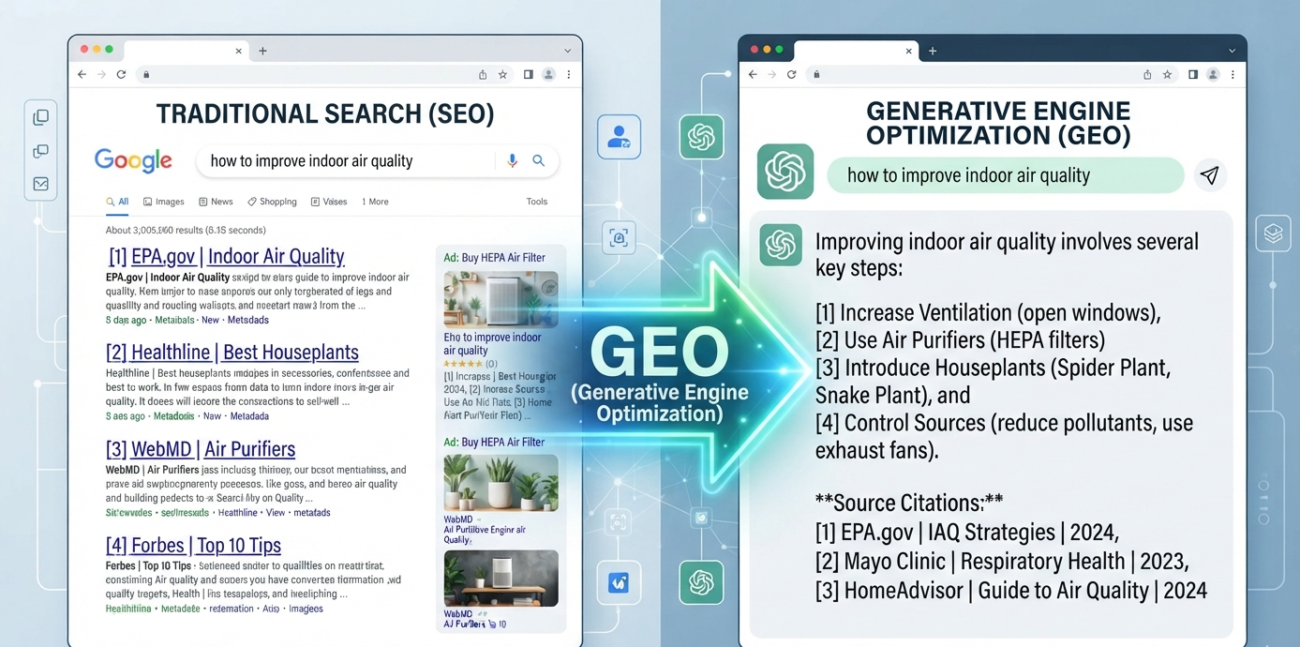
For almost twenty years ranking on the first page of Google was the finish line of digital marketing. Businesses fought for the top three blue links, paid for ads and celebrated when their website finally cracked position one. That race still matters — but it is no longer the only race, and for a growing number of searches, it is not even the main one anymore.
In 2026, hundreds of millions of people are no longer typing a keyword into Google and scrolling through ten links. They are asking ChatGPT, Perplexity, Gemini, or Google’s AI Overviews a full question — which is the best web hosting for a small business in Pakistan, how do I start freelancing with zero investment, what is the best AI tool for content writing — and getting one direct, synthesized answer. No scrolling. No comparing five tabs. Just one paragraph, often with two or three sources quietly cited underneath it.
If your website isn’t one of those sources, you don’t just lose a click. You become invisible to an entire generation of searchers who now trust AI to do the research for them.
This is exactly the problem that Generative Engine Optimization (GEO) exists to solve. This guide will walk you through what GEO actually is, how it’s different from traditional SEO, why it matters so much right now, and — most importantly — the exact, practical steps you can start using today to get your business, blog, or course website mentioned inside AI-generated answers.
What Is Generative Engine Optimization (GEO)?
Generative Engine Optimization (GEO) is the practice of structuring, writing, and publishing content so that AI language models – ChatGPT, Perplexity, Google Gemini, Google AI Overviews, Claude, and Microsoft Copilot – can easily read, understand, trust, and cite it when they generate an answer for a user.
In simple words: SEO gets you a spot in a list of links. GEO gets your business named inside the answer itself, sometimes without the user ever clicking through to a traditional results page at all.
The concept isn’t brand new – the term Generative Engine Optimization was first used in a 2023 academic research paper from Princeton University, Georgia Tech, and IIT Delhi, and it gained mainstream traction after being presented at a major data-science conference in 2024. But by 2026, GEO has moved from an experimental idea discussed by researchers to a standard, budgeted line item in almost every serious marketing plan.
GEO vs SEO vs AEO — What’s the Difference?
These three terms get used interchangeably, but they are not the same thing.
| Factor | Traditional SEO | AEO (Answer Engine Optimization) | GEO (Generative Engine Optimization) |
| Goal | Rank in a list of links | Win the featured snippet / voice answer | Get cited inside an AI-generated response |
| Platform | Google, Bing search results | Google featured snippets, voice assistants | ChatGPT, Perplexity, Gemini, Claude, AI Overviews |
| Success metric | Rankings, clicks, impressions | Snippet ownership | Citation frequency, AI “share of voice” |
| Content style | Keyword-optimized pages | Short, direct single answers | Structured, comprehensive, fact-dense content |
| User outcome | User clicks your link | User reads a short box, may click | User reads AI’s synthesized answer, may or may not click |
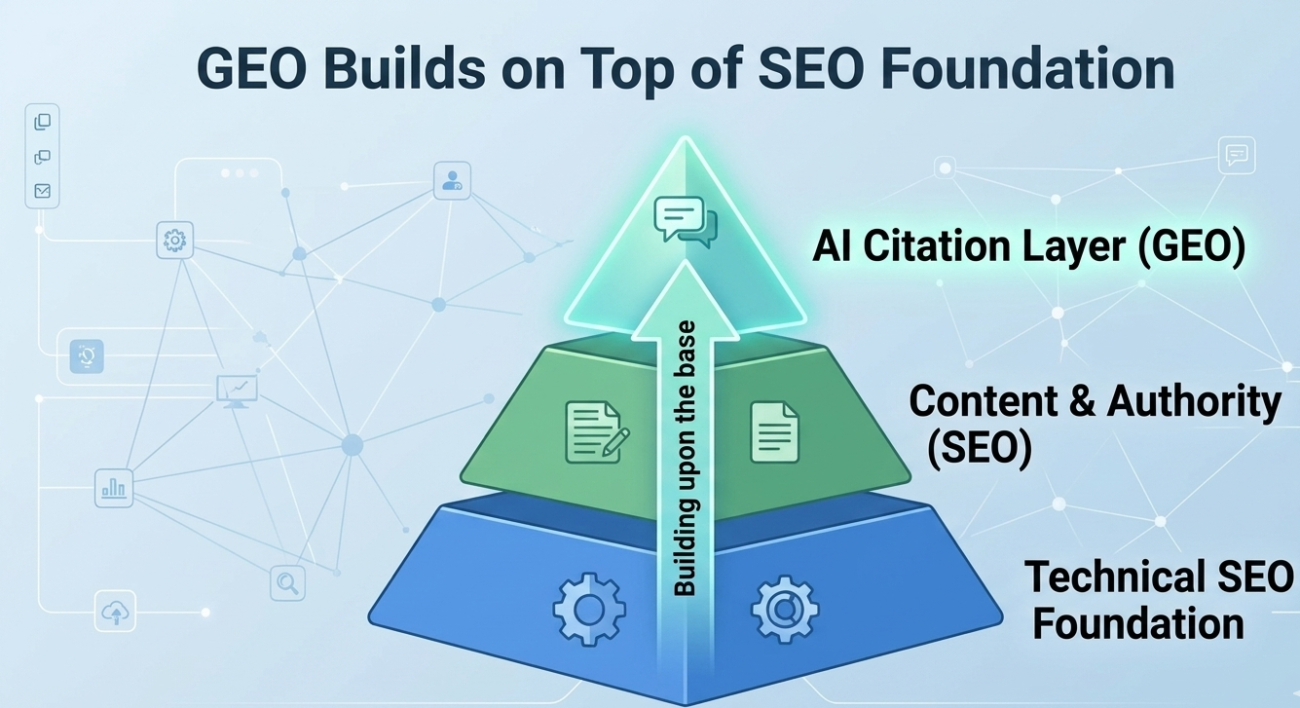
GEO does not replace SEO – it builds on top of it. AI engines still rely heavily on crawlable, well-indexed, authoritative web content as their raw material. If your site has weak technical SEO, broken structure, or thin content, no GEO tactic will save it. GEO is the next layer that decides whether AI trusts and reuses what SEO already helped it discover.
Why GEO Matters So Much in 2026
The numbers explain why marketers, agencies, and even small institutes are rushing to learn this skill:
- ChatGPT alone now serves several hundred million weekly active users, many of whom use it as their first stop for research-style questions instead of a search engine.
- Google’s AI Overviews already appear on a meaningful share of everyday search queries, and that share keeps climbing every quarter.
- Perplexity has grown into a dedicated answer engine that millions of professionals now use specifically because it shows its sources clearly, making it one of the friendliest AI platforms for publishers who want credit.
- Independent studies on AI-referred traffic have found that visitors who arrive from an AI platform tend to convert at noticeably higher rates than average organic visitors — because by the time they click through, the AI has already pre-qualified their interest.
The practical implication for a business, blogger, freelancer, or training institute is simple: the ten blue links strategy alone is no longer a complete growth plan. If your content is invisible to AI engines, you are quietly losing a growing slice of high-intent traffic to competitors who understood this shift earlier.
How AI Search Engines Actually Choose What to Cite
To optimize for something, you first need to understand how it makes decisions. Generative engines don’t work like classic search engines, and different platforms don’t even work like each other.
The Three-Step Process Behind Every AI Answer
- Retrieval — When a user asks a question, the AI engine searches its index (or performs a live web search) to pull a shortlist of relevant, credible pages.
- Synthesis — The model reads the content from those pages and rewrites the key facts into one coherent answer, blending information from multiple sources.
- Citation — Many engines (especially Perplexity and AI Overviews) attach small source links or footnotes next to the claims they used, so the user can verify or explore further.
Your entire GEO strategy is really about making your page the easiest, safest, most obviously correct choice at each of these three steps.
Platform-by-Platform Behavior
Not every AI engine reads content the same way, so a one-size-fits-all approach underperforms.
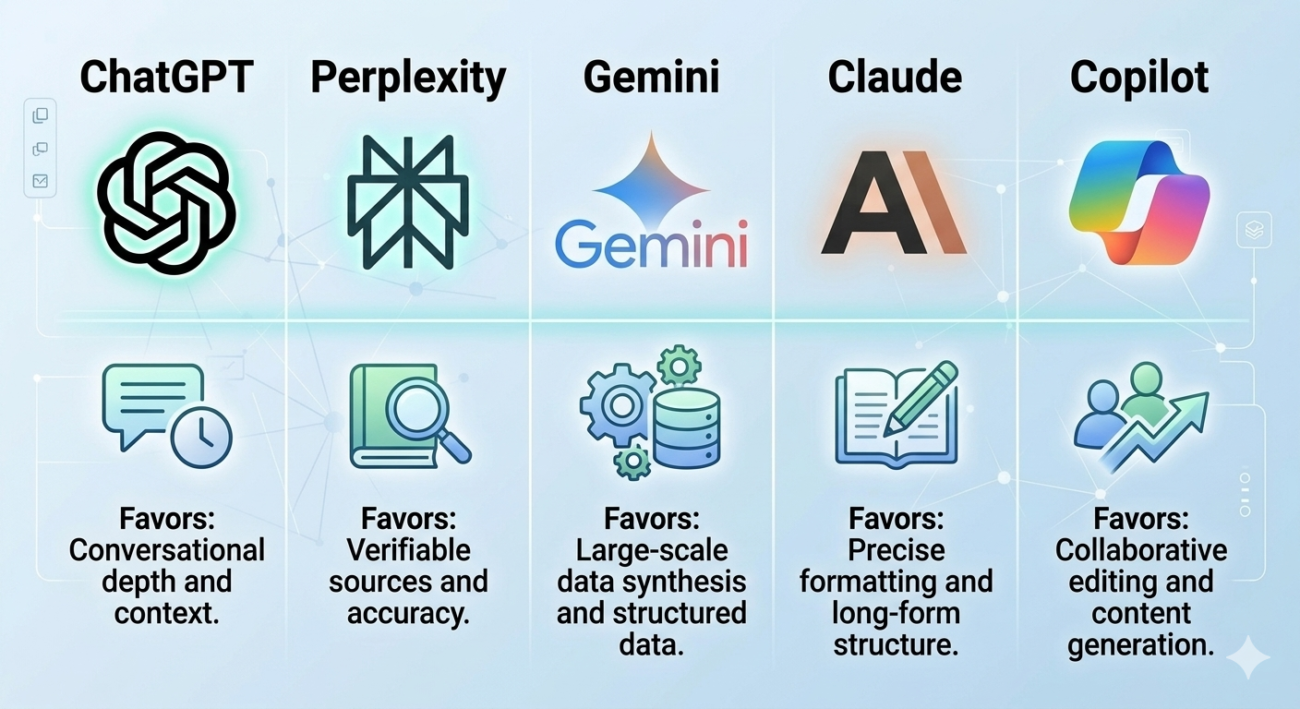
- ChatGPT Search tends to favor pages with strong overall domain credibility, clean formatting, and content that directly answers the conversational way people actually phrase questions.
- Perplexity is widely considered the most publisher-friendly engine. It leans on real-time web retrieval, shows clear source cards for nearly every factual claim, and rewards fresh, frequently-updated content.
- Google Gemini and AI Overviews inherit a lot of DNA from classic Google Search — meaning traditional ranking signals (backlinks, page experience, structured data) still heavily influence whether Gemini even considers your page.
- Claude is particularly good at parsing well-organized technical or instructional content, so detailed how-to guides and documentation-style pages tend to perform well here.
- Microsoft Copilot leans on the Bing index, so classic Bing Webmaster Tools optimization still plays a supporting role.
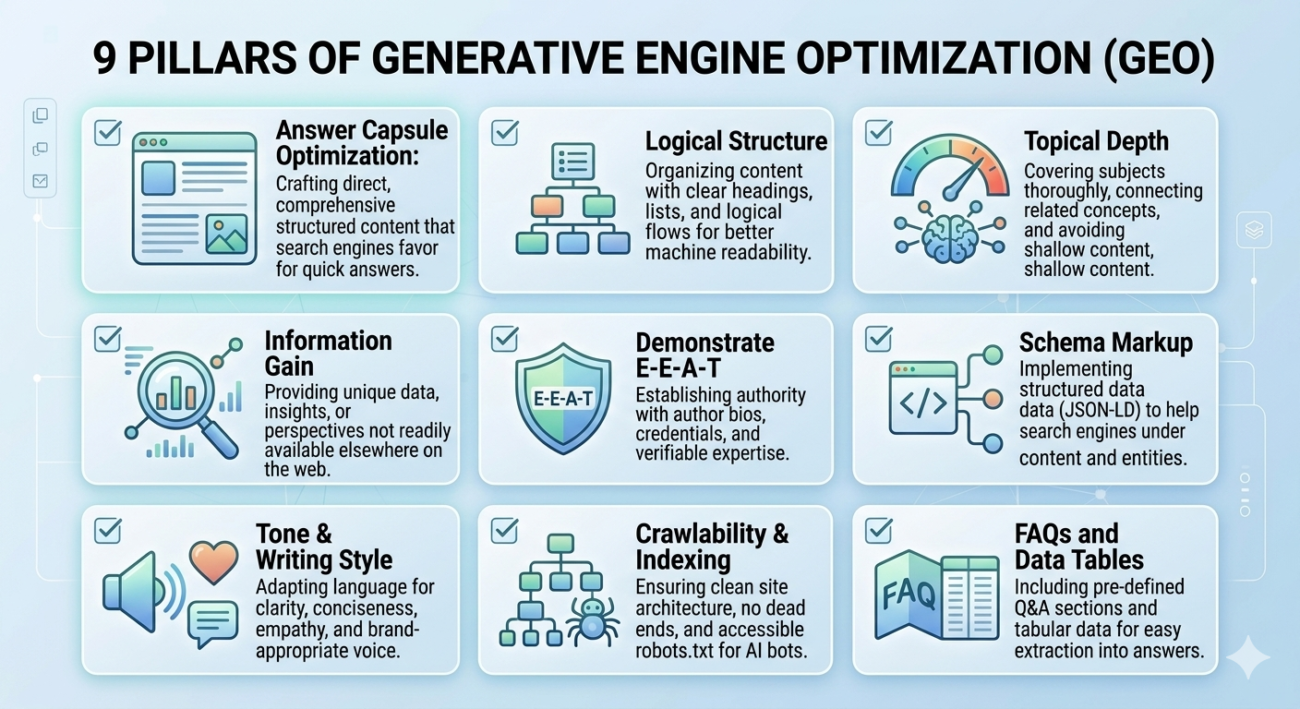
The Core Pillars of a Winning GEO Strategy
Here is the practical part — the actual tactics you can apply to your website, blog, or client’s site starting today.
1. Lead With a Direct “Answer Capsule”
AI models love content that gives them a ready-made sentence they can lift almost word-for-word. If your article is about What is Generative Engine Optimization?, don’t bury the definition in paragraph four. Give it immediately, in one clean, quotable sentence, right after the heading.
This single change — placing a tight, self-contained definition or answer within the first 40–60 words under a heading — has been shown in independent GEO research to noticeably increase citation rates compared to pages that make the AI dig through scattered information to piece an answer together.
Practical tip: For every H2 or H3 on your page, imagine someone asked that exact heading as a question to ChatGPT. Your first sentence under that heading should be the answer.
2. Structure Content the Way Machines Read, Not Just the Way Humans Skim
Classic SEO already rewarded good structure. GEO makes it non-negotiable. AI crawlers extract information far more reliably from:
- Clear H2/H3 headings that describe exactly what the section covers
- Numbered steps for processes
- Bullet lists for features, benefits, or comparisons
- Comparison tables (like the SEO vs GEO vs AEO table above) — these are extremely citation-friendly because AI can lift a row or two cleanly
- FAQ sections using actual question-style headings
Avoid long, unbroken walls of text. If a paragraph runs past 4–5 sentences without a subheading, list, or table to break it up, an AI model has to work harder to extract a clean answer — and it will often choose a competitor’s easier-to-parse page instead.
3. Build Real Topical Depth, Not Just One Article
AI engines increasingly reward what researchers call “entity-rich topical depth” — meaning your site as a whole, not just a single blog post, demonstrates real expertise on a subject through interlinked content clusters.
If your institute teaches digital marketing, freelancing, and web design, don’t publish one isolated article on GEO and stop. Build a small cluster: a pillar guide (this article), supporting posts on AI tools for marketers, on-page SEO basics, and content writing tips — all linked to each other. AI engines pull confidence from seeing a site that clearly “owns” a topic area, the same way a human reader trusts a specialist over someone who wrote one lucky post.
4. Prioritize Information Gain — Say Something the AI Hasn’t Already Read a Hundred Times
This is the single biggest differentiator between content that gets cited and content that gets ignored. If your article simply repeats the same five facts every other “top 10 GEO tips” post already contains, an AI model has no strong reason to pick your specific page as the source — it already “knows” that information from a dozen other pages.
What genuinely moves the needle:
- Original data — even something as simple as “we tested this on our own site and saw X% change”
- A specific, practical example instead of a generic one
- A framework, checklist, or numbered process you created yourself
- An honest opinion or nuanced take, not just a restatement of consensus
Freshness matters too. Perplexity and AI Overviews in particular tend to favor recently published or recently updated pages, since they’re optimizing for the most current, accurate answer.
5. Strengthen E-E-A-T — Experience, Expertise, Authority, Trust
AI engines are cautious about citing content from sources that look anonymous, unverifiable, or low-effort — because doing so risks giving the user a wrong or outdated answer, which damages the AI platform’s own credibility.
To signal trustworthiness:
- Add a real author byline with a short bio and credentials (e.g., “Written by [Name], Digital Marketing Instructor at CyberInitiator “)
- Include a “last updated” date, and actually update the content periodically
- Link out to a small number of genuinely authoritative external sources when citing statistics
- Make sure your About Us, Contact, and Privacy Policy pages are complete and easy to find — AI systems and their underlying crawlers use these as trust signals for the whole domain, not just one page
6. Use Structured Data (Schema Markup)
Schema markup is a small piece of code added to your website that explicitly tells search engines and AI crawlers what your content is — an article, an FAQ, a course, a product, a review — rather than making them guess from plain text.
For a training institute like a digital skills academy, the highest-value schema types are usually:
- Article schema for blog posts
- FAQPage schema for any FAQ section (this is one of the most GEO-friendly formats that exists, because it hands the AI a ready-made question-and-answer pair)
- Course schema for course/diploma pages
- Organization schema on the homepage, to clearly establish your business identity, logo, and contact details
You don’t need to hand-code this — most WordPress SEO plugins (Rank Math, Yoast) can generate FAQ and Article schema for you with a simple block editor.
7. Write in a Natural, Conversational Tone
People don’t type keyword fragments into ChatGPT the way they used to type them into Google. Instead of typing best web hosting Pakistan cheap, a user now asks, What’s the best affordable web hosting option for a small business in Pakistan?
Your content should mirror that natural, full-sentence phrasing — in your headings, your FAQ questions, and your body copy. This isn’t just more pleasant to read; it directly increases the chance your exact wording matches the query pattern an AI model is trying to answer.
8. Make Your Site Technically Easy to Crawl
None of the above matters if AI crawlers can’t reach your content in the first place. Quick technical checklist:
- Make sure your robots.txt file isn’t accidentally blocking AI crawlers (GPTBot, PerplexityBot, Google-Extended, ClaudeBot)
- Submit an updated XML sitemap through Google Search Console and Bing Webmaster Tools
- Keep page load speed fast — slow, heavy pages get skipped more often during crawling
- Make sure your site is mobile-friendly, since most crawlers and a large share of AI users are on mobile
- Some sites in 2026 are also experimenting with a new llms.txt file — a simple text file that gives AI models a clean, structured summary of your most important pages, similar in spirit to how sitemaps guide traditional search crawlers
9. Add Comparison Tables and Structured FAQs — Deliberately, Not as an Afterthought
We’ve mentioned both already, but they deserve their own callout because the data on them is so strong. Pages that include a genuine comparison table (like SEO vs GEO vs AEO above) or a well-formatted FAQ section at the end are dramatically easier for an AI model to lift a clean, accurate excerpt from — which directly translates into a higher chance of citation.
A Step-by-Step GEO Action Plan You Can Start This Week
If all of this feels like a lot, here is a simplified rollout order:
- Audit your top 10 existing pages. Do they answer a clear question in the first two sentences? If not, rewrite the opening.
- Add or improve FAQ sections on your most important pages using FAQPage schema.
- Check your robots.txt to confirm AI crawlers are allowed in.
- Pick one pillar topic relevant to your business (for a training institute: how to start freelancing, AI tools for marketers, how to run Facebook ads) and build 3–4 connected supporting articles around it.
- Add at least one comparison table to your three highest-traffic pages.
- Add real author bios and update your About page.
- Republish and refresh your best-performing older content with new data, examples, and a more direct answer-first structure.
- Track your results using AI visibility tools (see next section) so you can measure what’s actually working.
How to Track Whether GEO Is Working
Traditional Google Analytics won’t show you the full picture, because a user who reads an AI answer that cites you may never click through at all — that’s a real result of GEO, but it’s invisible in click-based reporting.
A few practical ways to measure GEO performance in 2026:
- Tag AI referral traffic in GA4. ChatGPT, Perplexity, and Gemini do send some direct click-throughs, and you can filter these referral sources separately from regular Google traffic.
- Manually test your own key questions. Periodically ask ChatGPT, Perplexity, and Gemini the exact questions your content answers, and check whether your site is mentioned or cited.
- Use dedicated AI visibility tools. A growing category of tools (such as Semrush’s AI toolkit, Ahrefs’ brand-tracking features, and newer specialized GEO platforms) now track citation frequency, AI share of voice, and sentiment across ChatGPT, Perplexity, Gemini, and Claude — similar to how rank trackers worked for classic SEO.
- Watch branded search volume. An uptick in people searching your brand name directly is often a downstream sign that AI platforms have been recommending you.
GEO for Small Businesses, Freelancers, and Local Institutes
There’s a common myth that GEO only matters for huge global brands with unlimited budgets. In practice, the opposite is often true. AI models don’t weigh domain age or ad spend the way older algorithms leaned on backlink volume — they weigh clarity, specificity, and genuine expertise far more heavily. That means a small digital marketing institute, a local freelancer, or a one-person agency can realistically outrank a much bigger competitor inside an AI answer simply by structuring content better and answering questions more precisely.
For a local or regional business, a few extra tactics help:
- Answer location-specific questions directly. Instead of a generic “best web hosting” post, write “best affordable web hosting for small businesses in Pakistan” and answer it with local pricing, local payment options, and local examples. AI engines reward specificity over generic global advice.
- Keep your Google Business Profile and directory listings consistent. Gemini and AI Overviews pull heavily from Google’s own ecosystem, so an outdated or inconsistent business listing can quietly hurt your AI visibility even if your website content is excellent.
- Publish student, client, or customer success stories with real names and outcomes. These act as strong trust and originality signals — the kind of first-hand “experience” that E-E-A-T explicitly rewards, and that generic AI-written competitor content usually can’t fake.
- Don’t ignore Urdu/English mixed search behavior. Many users in Pakistan ask AI tools questions in Roman Urdu or a mix of Urdu and English. If your audience searches this way, consider including a few natural, conversational phrasings in that style within your FAQ section — it widens the range of real queries your content can match.
A Simple GEO Content Checklist Template
Save this checklist and run every new blog post through it before hitting publish:
- Does the first sentence under the main heading directly answer the core question?
- Are there at least 3–4 clear H2/H3 subheadings?
- Is there at least one comparison table or structured list?
- Is there a dedicated FAQ section with 4–6 real questions?
- Is FAQPage or Article schema enabled on this page?
- Does the article include at least one original example, statistic, or opinion not copied from competitor posts?
- Is there a visible author name and short bio?
- Is the publish or “last updated” date current and accurate?
- Are internal links added to 2–3 related articles on your site?
- Does the page load quickly and display properly on mobile?
If a post checks all ten boxes, it is in genuinely strong shape to be discovered, trusted, and cited by AI search engines — not just ranked by traditional Google algorithms.
Common GEO Mistakes to Avoid
- Treating GEO as a replacement for SEO. It isn’t. Weak technical SEO undermines everything else.
- Keyword-stuffing instead of answering clearly. AI models are far better at detecting unnatural, forced phrasing than older search algorithms were.
- Publishing generic, me-too content that repeats what dozens of other sites already say, with no new information, data, or perspective.
- Ignoring older content. A three-year-old, never-updated post is far less likely to be trusted by an AI engine that’s optimizing for current accuracy.
- Skipping structured data because it feels technical. Most modern SEO plugins make this a five-minute task.
- Writing walls of text with no headings, lists, or tables that force the AI to work harder than it needs to.
A Quick Real-World Example
Imagine two websites both publish an article on “how to start freelancing with zero investment.”
Website A writes 800 words in one long block of text, no subheadings, a vague opening paragraph, and no author name.
Website B opens with a clear one-sentence definition of what freelancing with zero investment means, breaks the content into clearly labeled steps (“Step 1: Choose a skill,” “Step 2: Build a portfolio,” etc.), includes a comparison table of three beginner-friendly freelance platforms, adds an FAQ section with FAQPage schema, and closes with a short author bio from a real instructor.
When a user asks ChatGPT or Perplexity “how can I start freelancing with no money,” Website B is structurally built to be the easier, safer, more citation-ready source — and in practice, this is exactly the kind of formatting difference that separates sites that get quoted from sites that get skipped, regardless of which one technically “ranks higher” in classic Google terms.
Frequently Asked Questions About GEO
Is GEO replacing SEO in 2026?
No. GEO extends SEO rather than replacing it. AI engines still rely on the same crawlable, indexed, authoritative web content that traditional SEO helps build. Think of GEO as an additional layer on top of a healthy SEO foundation, not a substitute for one.
How long does it take to see results from GEO?
Many businesses that implement structured GEO practices — answer-first formatting, schema markup, FAQ sections, and topical depth — start noticing early citations within roughly four to eight weeks, though this varies by platform, niche competitiveness, and how frequently the AI engine re-crawls your site.
Do I need to hire a developer to do GEO?
Not for the basics. Most core GEO tactics — restructuring your intros, adding FAQ sections, building comparison tables, and enabling schema markup through an SEO plugin — can be done directly inside WordPress with tools most bloggers and marketers already use.
Which AI platform should I prioritize first?
If you’re just getting started, Perplexity is often the most beginner-friendly place to test your strategy, because it shows clear source citations for almost every factual claim, making it easy to check whether your changes are actually working.
Does GEO work for small or local businesses, not just big brands?
Yes. In some ways, GEO levels the playing field more than traditional SEO did, because AI models care more about clear structure, genuine expertise, and specific answers than about domain age or advertising budget. A well-structured local business page can absolutely outperform a poorly structured big-brand page in AI citations.
Final Thoughts
Search behavior only moves in one direction — forward. Just as businesses that ignored mobile-friendly design lost ground in the 2010s, businesses that ignore Generative Engine Optimization now are quietly losing visibility with every passing month, even if their traditional Google rankings still look fine on the surface.
The good news is that GEO, at its core, rewards exactly the things that make content genuinely useful: clear answers, honest structure, real expertise, and up-to-date information. It isn’t a trick or a loophole — it’s simply the next version of “write good content and make it easy to find,” adapted for a world where AI is often the first reader before a human ever is.
If you want to build these skills properly — from on-page SEO fundamentals to AI-powered content writing and the exact structuring techniques covered in this guide — this is exactly what we teach hands-on inside our Digital Marketing Fundamentals, Content Writing & Blogging, and SEO courses at CyberInitiator Institute of Professional Studies. Enroll today and start building content that both Google and AI can’t ignore.